


This essay is adapted from the Frankly episode posted on August 1st, 2025, titled “The Ghost of Dopamine Past.”
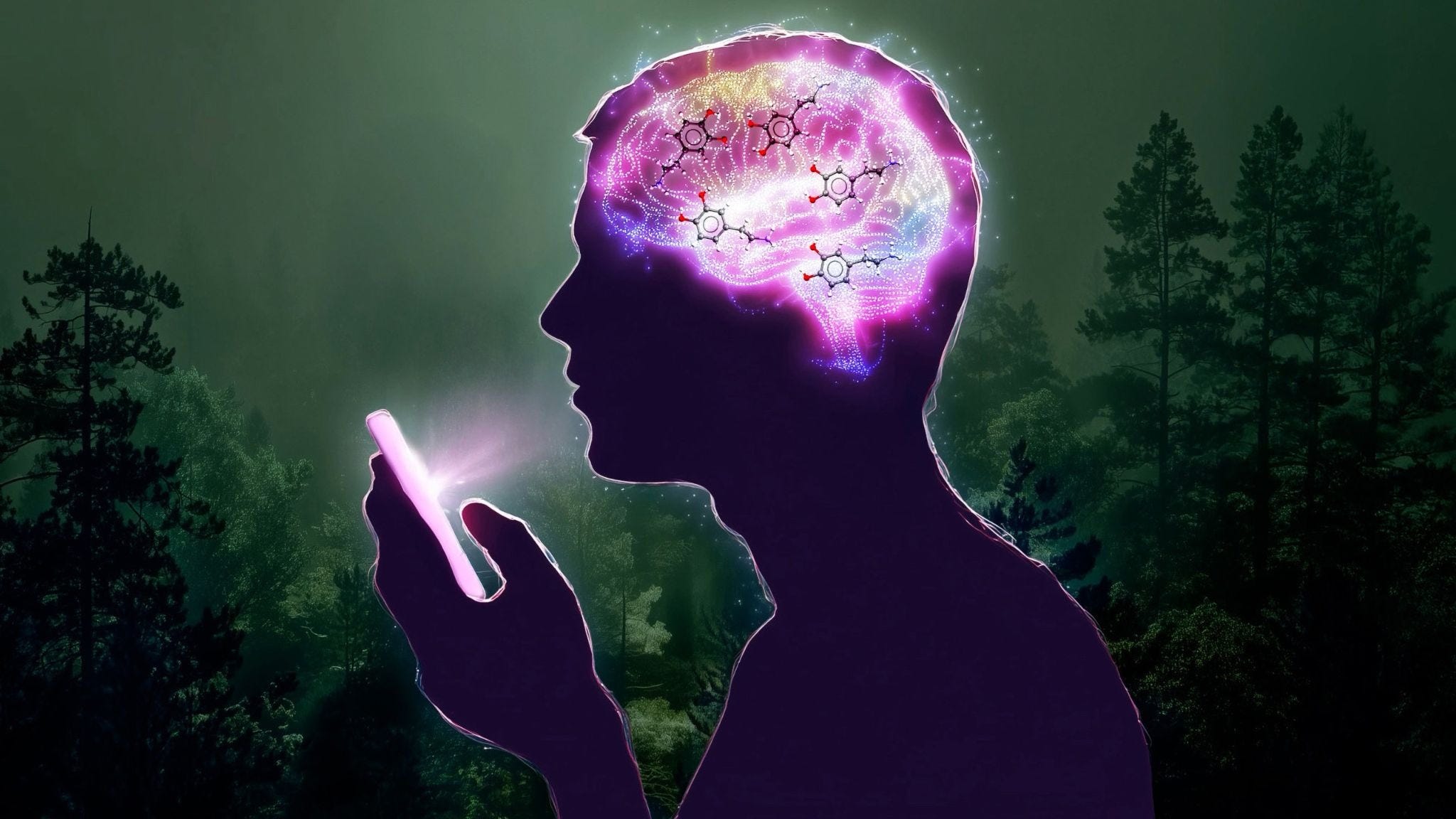
Last year, I had a really amazing bike ride that led to one of those “aha” lightning-strike moments. It happens to be related to our collective more-than-human predicament, so I wanted to share the story and reflections.
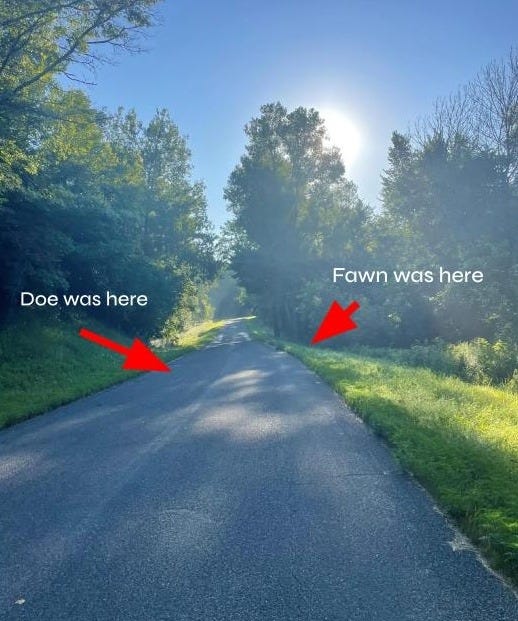
I was biking and had my phone with me (which I almost always do), when I got a notification from LinkedIn. It was a message from a woman who I don’t know (a friend of a friend), who is a movie director and wanted me to be in a film on humans, nature, and our predicament. While I was reading it – unfortunately thinking “I don’t have time to do this” – all of a sudden a doe and a fawn were right in front of me, standing in the road, staring at me. I almost ran into them because I was looking down, and they were probably less than 25 yards ahead of me by the time I stopped.
It struck me that I was looking at a piece of technology, reading about a movie that’s literally about humans and nature … while I was missing the nature that was right in front of me. It felt like this profound microcosm of the entire more-than-human predicament: how our brains, our hearts, and our values are co-opted by the technology, incentives, and experiences of this culture. Another human being on that bike ride might not have been captured or distracted the way that I was. To be honest, it’s only since this podcast and platform have taken on a larger portion of my life that I’ve really become subject to what I refer to as “the ghost of dopamine past.”
That’s what I’d like to talk about today: the neuroscientific foundations of the ghost of dopamine past and its relevance to our collective predicament.
All About Dopamine
Dopamine. We’ve heard a lot about this neurotransmitter. It was 20 years ago when I was getting my PhD that I first became interested in climate change, ecology, and energy, but I was very quickly drawn toward evolutionary biology, neuroscience, and human behavior as well.
I befriended a neuroscientist, Peter Whybrow, who was on this podcast a few years ago. He had written a book called American Mania, which is where I discovered a famous neuroscience experiment from the 1990s by Wolfram Schultz and his colleagues. That experiment has become quite important to my understanding of human behavior.
This study involved monkeys performing a reward-based learning task while researchers recorded the dopamine neurons in their midbrain. The monkeys were learning to associate cues like lights or sounds with receiving a drink of fruit juice as a reward. When the monkeys first received this unexpected juice, the researchers noticed that their dopamine neurons surged. The monkeys’ dopamine neurons were showing what researchers call a reward-prediction error, because they didn’t know why they got juice, and it was awesome. But once the monkeys learned to predict the reward, the dopamine neurons stopped firing when they received it. Instead, they fired when the predictive cue appeared, which was the sound that played.
If the researchers played the sound and there was no juice, the monkeys’ dopamine neurons showed a dip below their original baseline – essentially the neural signal of disappointment. The key insight from this is that dopamine neurons don’t simply signal a reward. They actually signal the difference between expected reward and actual reward.
All of this helps explain why we adapt to positive circumstances, and why pleasures that we are familiar with and anticipate often feel less rewarding than the unexpected ones. I think this finding has major implications for understanding addiction, motivation, decision-making, and therefore – as many of you might guess – the more-than-human predicament.
Dopamine and the More-Than-Human Predicament
If unexpected rewards are what drive us, and there’s a gap between the flow-based world in our minds and the real, material-based world … that poses a big problem.

People who have watched my lectures for the last 20 years know I use this example of Parkinson’s disease – which my father actually has right now, though he doesn’t have these other symptoms. Parkinson’s disease is a neurodegenerative disorder that affects movement, in part because of the loss of dopamine-producing neurons in the brain. Some of the drugs used to treat it, like Mirapex, increase dopamine signaling in the brain. But these drugs can’t just target one tiny area, they can affect other parts of the brain as well. This means that sometimes, some patients develop impulse-control problems where they become gambling addicts, spend their entire life savings on shoes, take up smoking, or have multiple affairs.
As dopamine signaling ramps up in our brain, we go out and pursue more consumptive, reward-based behavior. The dopamine response we used to get from going through our daily lives – reading a book, having our cousin come and visit, or going for a walk – doesn’t cut it anymore. When I was growing up, I would get so much dopamine from going fishing in Canada with my family. There would be zero bites for hours, and then all of a sudden, a big strike from a Northern pike on the line. I felt an intense dopamine hit from that! But these days we get those spikes every day from all the email notifications, likes, video games, and other ways of accessing super-high-level stimulation 24/7. What can end up happening is that we need more frequent, more intense stimulation in order to feel the same sensations that we used to.
Returning to the biking moment I started with: while it’s so cool that I was being invited to be in a movie, it struck me that this sort of email shouts louder in my brain than seeing a doe and her fawn standing right in front of me.
I feel overly busy with all the things that we’re trying to do with this platform. I get so many emails, requests, and introductions that I think I’m actually way more of a dopamine addict today than I was five years ago teaching college. It’s something I’m personally trying to address, but this isn’t just about me. That’s why I’m sharing it with you. This is about our entire culture.
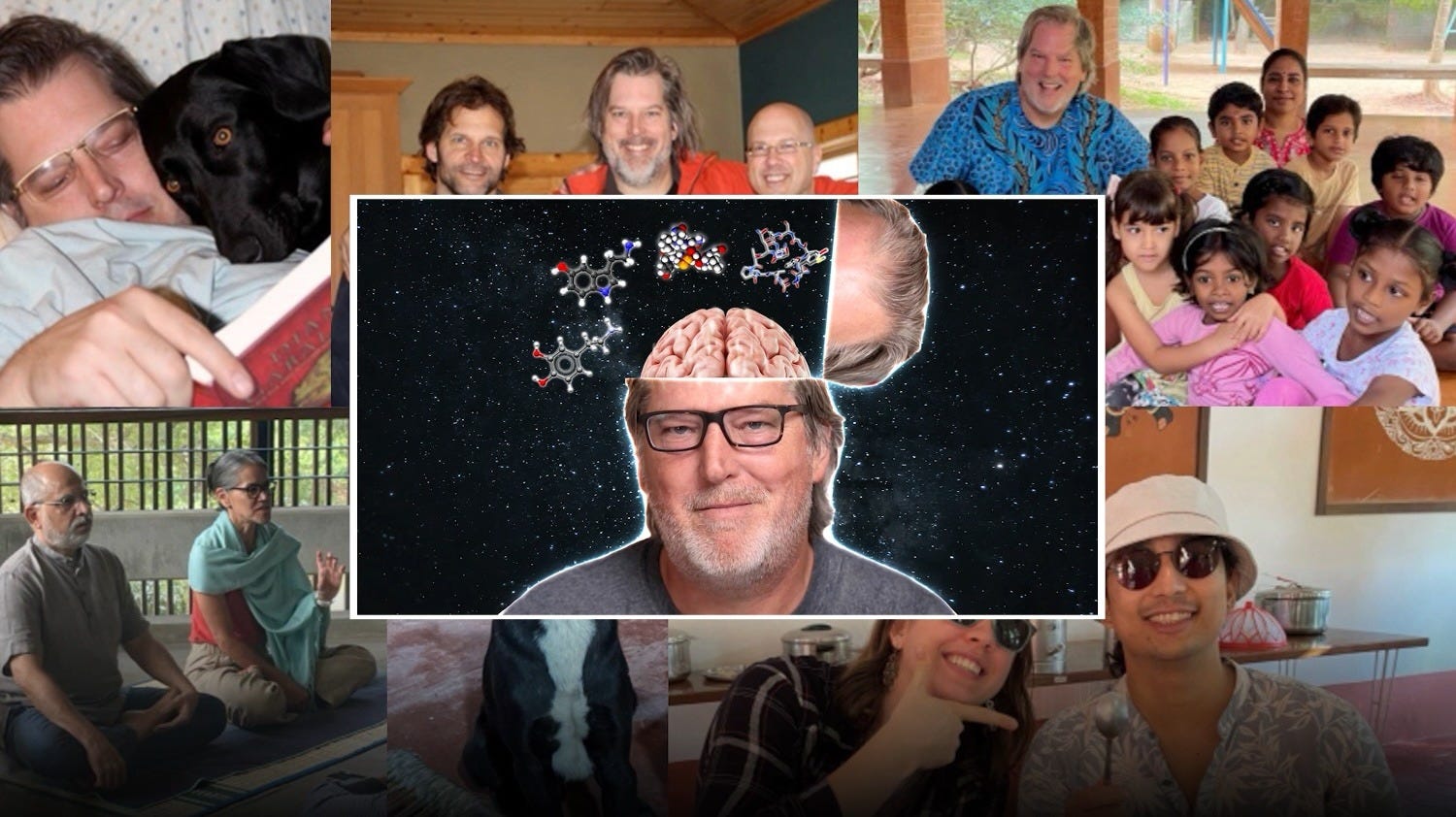
So when I refer to “the ghost of dopamine past,” I’m referring to our behaviors, our decisions, and our activities. Specifically the way they end up reinforcing habits and neural pathways in our brain that make us more and more drawn to attention-grabbing, quick rewards and desensitized to everyday things. So a doe and a fawn, or sitting for 30 minutes on a park bench looking at birds, or reading a book no longer feel the same.
Those of us that go through life with really hungry ghosts of dopamine past end up having over-consumptive and unhealthy ghosts of dopamine present. And if the ghost of dopamine past is strong enough, it constrains our visions of the future, because we can only envision things that keep us on this high treadmill.
Becoming Less Dopamine Hungry
So what do we do to respond to this?
I think one recommendation someone could try is so-called dopamine fasting, where you create certain periods in your day to disengage from dopamine-hungry behaviors. Recently, I’ve been trying to work in chunks, where I work for forty minutes, take a ten-minute break, work another forty minutes, another ten-minute break. In the “break” times, particularly if I’m working on something online, I will actually turn off the internet and disconnect. This could also come in the form of “technology-free Saturdays” or “phone-free mornings.”
Another intervention is to interject a dopamine neurotransmitter “speed bump” or a pause. When you want to check your phone, just take a breath first. Allow it to separate the trigger and the response, even if just in a very small way. I think over time those small pauses give us a little control over the moment.
Another suggestion: lower the level of stimulation you regularly expose yourself to. Audrey Tang, during my podcast with her last year, suggested turning your phone to grayscale. It actually makes a big difference. When you see everything in gray, you can read the information without the bright purples and blues, which really do raise your novelty threshold.
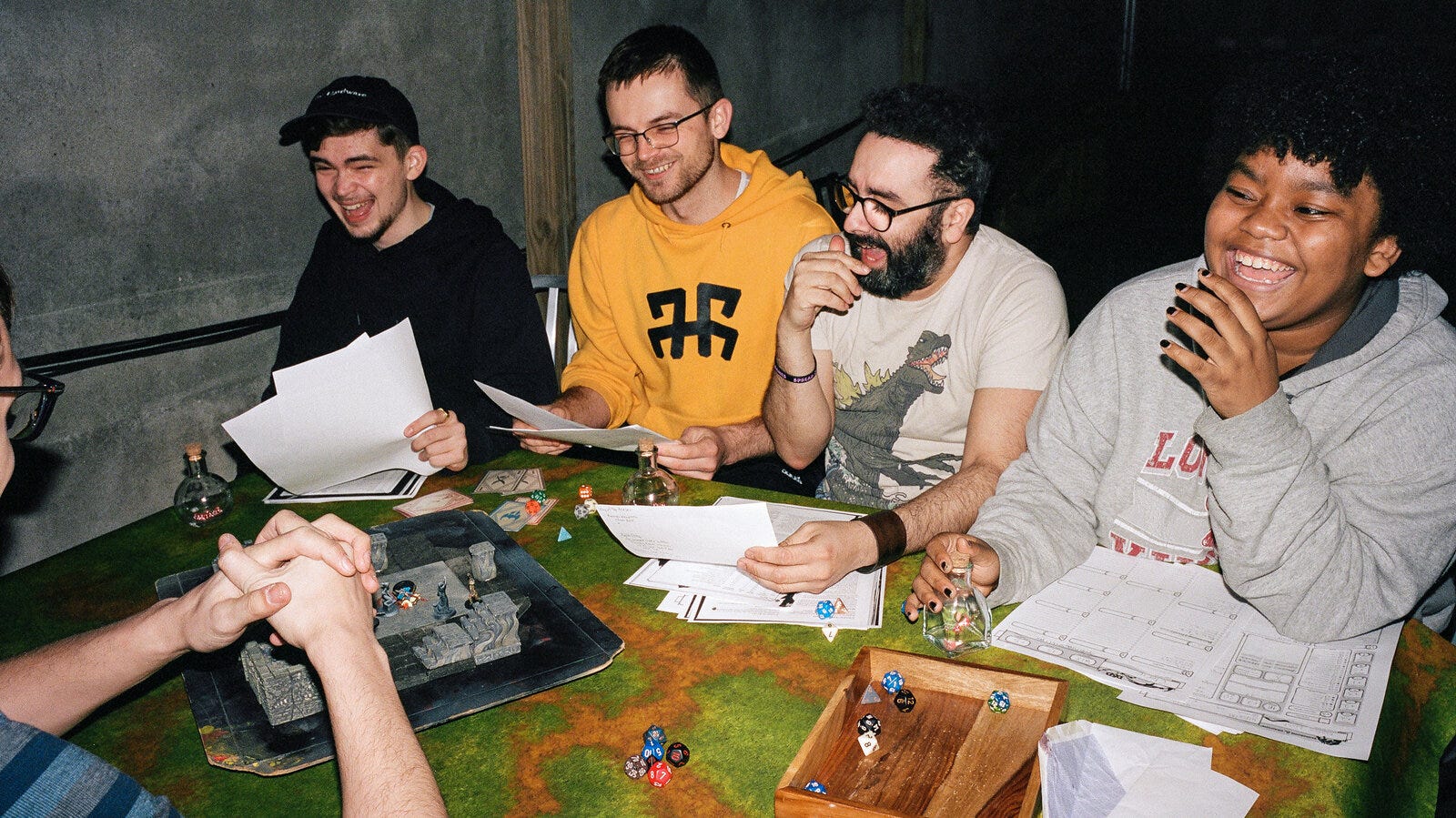
You can also work to socialize the dopamine. At least when you’re with other people, you get a better neurotransmitter cocktail than just sitting alone playing Candy Crush or puzzles, or scrolling for two hours. I’ll bring up some of my favorite forms of this: Dungeons & Dragons and Magic: The Gathering. In my opinion, these are two of the best games ever (and best inventions ever by humans) because you’re imagining these virtual worlds in your minds with other people. It’s the perfect full smorgasbord of creativity and socialization and emotion – you’re sitting there cracking jokes, slapping people on the back, being creative, being scared, being motivated, and all the things. All without using a lot of resources.
I don’t have concrete answers to this, but I think the ghost of dopamine past is a pretty strong driver in our lives, at least in the technologically connected Global North and West.
A few reflective questions based on all this:
If you think about what this does to us as individuals, what do you think it means for our society?
What about these four recommendations I just gave – what are the corollaries of those, but for our culture instead of the individual?
What are some ideas, suggestions, and mitigations you have for this dopamine culture that we find ourselves in?
How are you drawing your own boundaries and learning to cope with all of this?
I will say, I think the average follower of this platform probably has a much less hungry ghost of dopamine past than the average person – certainly less hungry than me – because you have the time span to listen to a ninety-minute podcast. That’s unusual these days, and I genuinely think you should pat yourself on the back for that. Everything else being equal, it means you have a healthy attention span.
These are just some of my thoughts, but I would be curious to hear yours. Thanks for reading, and for following along with my own learnings. I will talk to you next week.
Want to support The Great Simplification podcast?
The Great Simplification podcast is produced by The Institute for the Study of Energy and Our Future (ISEOF), a 501(c)(3) organization. We want to keep all content completely free to view globally and without ads. If you’d like to support ISEOF and its content via a tax-deductible donation, please use the link below.
Hi Nate, I love everything about TGS. I'm 67 and lucky enough to spend my days working the farm my wife and I bought 20 years ago after leaving IT jobs in Scotland. I'm a Kiwi and we live in NZ. We still graze calves on our easy land but have fenced off and planted almost a hundred acres of steeper land into native forest for biodiversity and catchment protection. After 19 winters planting trees, I now spend all of my free time with secateurs and a chainsaw doing silviculture in our forest so that some future owner has the option to run a Continuous Cover Forestry operation long after we're dead. I'm surrounded by thriving nature and listen to podcasts many hours per day. Often, I miss long stretches of the interviews when I'm up a ladder concentrating on what my chainsaw is doing. So I frequently hit repeat and listen to the same Frankly or TGS episode several times in a row to squeeze every last drop of goodness out of it. It struck me as kinda funny reading this essay that I spend seven days a week out in nature, immersed in meaningful work that brings me joy, yet my biggest dopamine hit of the week comes from seeing your latest podcast arrive with another load of depressing things to contemplate. Keep up the great work!!
When I’m in nature, riding my bike or hiking I silence my phone or leave it at home(feeling anxious “what if something happened?”) - override the anxiety and just do it. I also always have notifications off. I’m with people all the time whose phones are buzzing, chirping, ringing etc and most leave the moment to attend to whatever matter seems more important. It’s amazing and frustrating to witness. Our attention is gold and we need to honor how precious it is and discern what needs it now. Maybe the doe and fawn showed up as a gentle reminder. Thanks for your essays.