


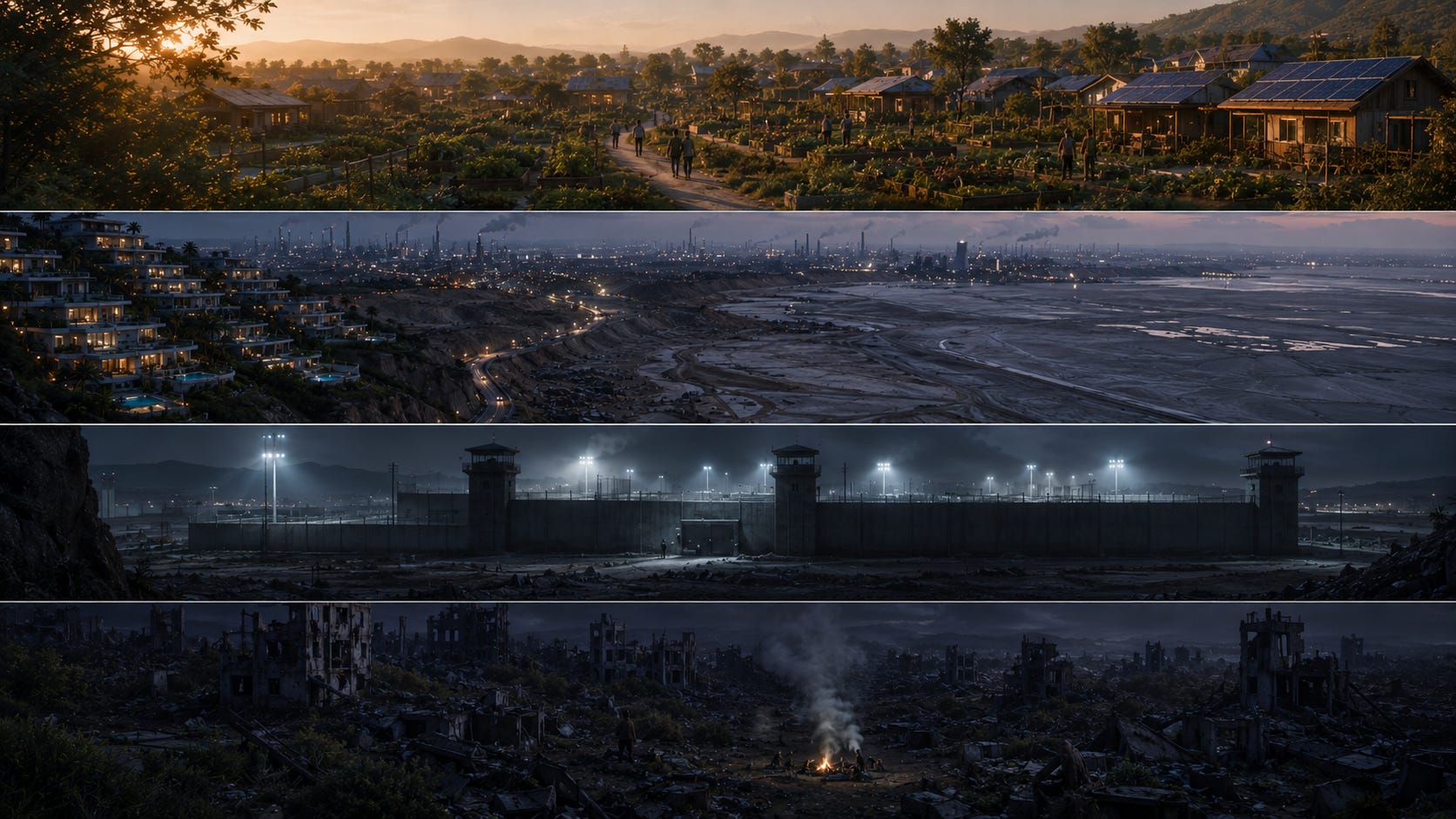
This week, I continue my “How to Think About the Future” series, where I invite listeners to imagine what it’s like to live in different versions of the reality that lies ahead. In today’s edition, I build upon the frameworks outlined in part three to create four distinct future worlds – composites that emerge from various combinations of economic conditions, geopolitical scenarios, power structures, and Earth systems stability. The resulting worlds are not meant to serve as a prediction, but as a set of thought experiments designed to stretch our imagination and to sharpen our understanding of how societal shifts show up in our everyday lives.
Along the way, I also explore why some of these futures seem more stable than others, why economic contraction does not necessarily mean collapse, and why power distribution may matter more than the economic headlines. As I unpack the logic of the four potential worlds, I emphasize that we are not yet locked into any one outcome – the choices made by communities, regions, and institutions today still determine which valleys remain reachable tomorrow. This episode is an invitation to think beyond conventional narratives of progress and to consider what conditions make a future not just stable, but worth living in.
What would daily life actually feel like in a world of managed contraction, ecological overshoot, authoritarian control, or systemic breakdown? Which institutions and practices are most important to preserve today, while the future remains unwritten? And why might the most desirable future also be the one that looks least like progress by today’s economic measures?
Want to dive deeper into the concepts covered in this episode? Follow along with the Show Notes & Links to Learn More, which you can find at the bottom of the page for every episode of The Great Simplification, or you can download them here.
In case you missed it…
In this week’s episode, I was joined by earth scientist and thermodynamicist Tad Patzek for an exploration of the mechanics and mathematics of global heating itself. Tad explained why CO₂ has such an outsized effect in contrast to its small concentration, how water vapor amplifies the greenhouse effect, and why climate models sometimes get things wrong. His new research, currently under peer review at Geophysical Research Letters, identifies a declining Earth albedo as an additional accelerant of warming over the past 26 years. Combined with accelerating ocean heat absorption, melting ice sheets, and the dynamics of an approaching Super El Niño, Tad argued the warming curve itself may be bending upward.
Want to support The Great Simplification podcast?
The Great Simplification podcast is produced by The Institute for the Study of Energy and Our Future (ISEOF), a 501(c)(3) organization. We want to keep all content completely free to view globally and without ads. If you’d like to support ISEOF and its content via a tax-deductible donation, please use the link below.
Thank You, Nate. I assume a world where our "owners" (Carlin) continue to cull us, their herds of humans, to reduce our draw on resources, while maintaining industrial economy, their manufacturing-interests.
My actions are to prepare large vegetable gardens, which I tend, and to keep our rural homestead in a stable town of 6000 in the Texas coastal plains. It was settled in the 1850s byGerman and Czech/Bohemian farming-communities fleeing wars in Europe.
I still have to watch out for subtle methods of culling, such as mandatorymass-injections, as we now know...
Food, water and electricity are likely to undergo crises, such as have been prepared by what has already transpired around the Strait of Hormuz.
This will make us more compliant with the deal we are about to get.
Please find a very sobering assessment of the situation we are in:
http://beezone.com/current/the-big-picture.html 1995 talk
Three related references
http://beezone.com/current-102.html The Pleasure Dome Law
http://beezone.com/whats-new a set of sobering references
http://www.nottwoispeace.org