

[Essay] Foundations Before Outcomes: The Future Beneath Your Feet
How to Think About the Future (Part 5)

This essay is adapted from the Frankly episode posted on July 10th, 2026, titled “Foundations Before Outcomes: The Future Beneath Your Feet,” which is from the series “How to Think About the Future.”
Hello there. Today I want to share the next part of my ongoing series, “How to Think About the Future.” So far, we’ve been exploring how to engage in scenario thinking in order not to limit our thinking about the future, and to open up multiple scenarios that are affected by the actions we take in our daily lives. Originally, I’d outlined this fifth part to be about robust action and no-regret responses to the composite worlds I had outlined in part four. But on a bike ride recently, I realized something was missing ahead of that.
This whole series has been about civilizational futures. We’ve built 2x2 grids describing macro-scale stuff – economies, power structures, geopolitics, and the Earth systems underneath everything else. We’ve engaged in various composite worlds that attempt to convey how future scenarios’ daily lived experiences might feel. We’ve looked at the landscape to reach those various futures as an assortment of valleys and ridges, which are navigated by creating switchbacks that inch us toward better futures. This entire series has been aimed at helping us think about what’s coming – not just for ourselves, but also for societies, nations, and the biosphere.
Every single person reading this is also navigating a personal version of the same landscape – and the dynamics are strikingly similar between the personal and civilizational. So today I want to turn the lens inward and ask: what do these landscapes look like at the scale of a single human life?
In this part, I’ll outline four things that are precursors to taking action in order to move toward better futures. First, I discuss two dimensions that we have to personally navigate: material throughput and agency. I then outline two foundations that lie underneath these dimensions, which constrain what is possible: the functioning of our bodies and nervous systems and our relational webs.
Let’s start with the first dimension.
Dimension: Throughput
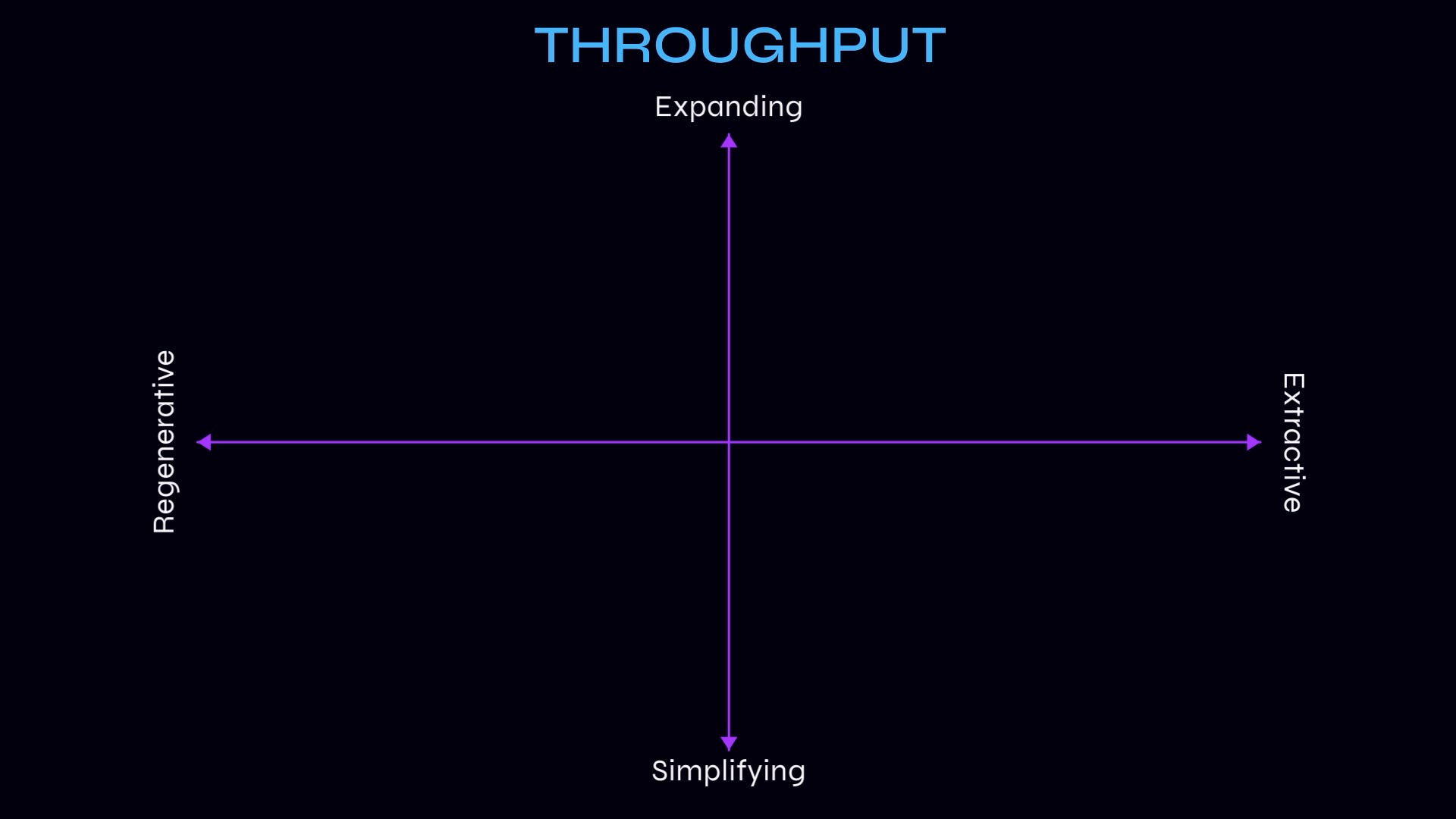
At the macro level I outlined in part two, we asked whether the economy is growing or contracting, and whether that growth or contraction is regenerative or extractive. At the personal level, the question is pretty much the same: is your material throughput expanding or simplifying, and is that building you up or wearing you down?
It’s important to point out that these are independent things. You can be expanding your income, your career, your commitments, and your consumption in a regenerative way, but only if it’s actually aligned with what matters to you: capability, relationships, meaning, and personal development. Expansion can also be extractive. Your career grows but it feeds on your time with your kids, your dogs, or your passions. Your income rises but your health declines to fuel it. Your social presence expands but the depth of your actual relationships thins out. More activity and throughput, but with less life.
You can be simplifying in a regenerative way, such as spending less, owning less, doing less. You drop the obligations that were draining you and discover you sleep better and think more clearly. On the other hand, simplification can also just be plain decline. You’re contracting because you’re exhausted, you’ve given up, or you just can’t sustain what you were doing anymore. The simplification isn’t chosen … it just arrives.
What I would call the “Personal Mordor” scenario is the one I think many people reading this might recognize. Perhaps uncomfortably. Your throughput is expanding, and the metrics look fine because your income, career, productivity, and social presence are all expanding. Underneath that growth, you’re drawing down the principal: your health, your close relationships, your creative capacity, your ability to actually be present in the moment. But the scorecard, at least the one our culture taught us to check, says you’re doing great.
In contrast, the scenario of “Personal Long Repair” looks like failure by those same cultural metrics, but it feels like coming back to life. There’s less status, less stuff, less busyness, and maybe less money. But there’s more sleep, more meals cooked at home, more connection to the web of life outside, and more actual conversations. Just like the civilizational version, this might look like decline or failure to most people in our culture.
Unless you’re surrounded by others with very similar ideals and practices, that can feel really difficult.
Dimension: Agency
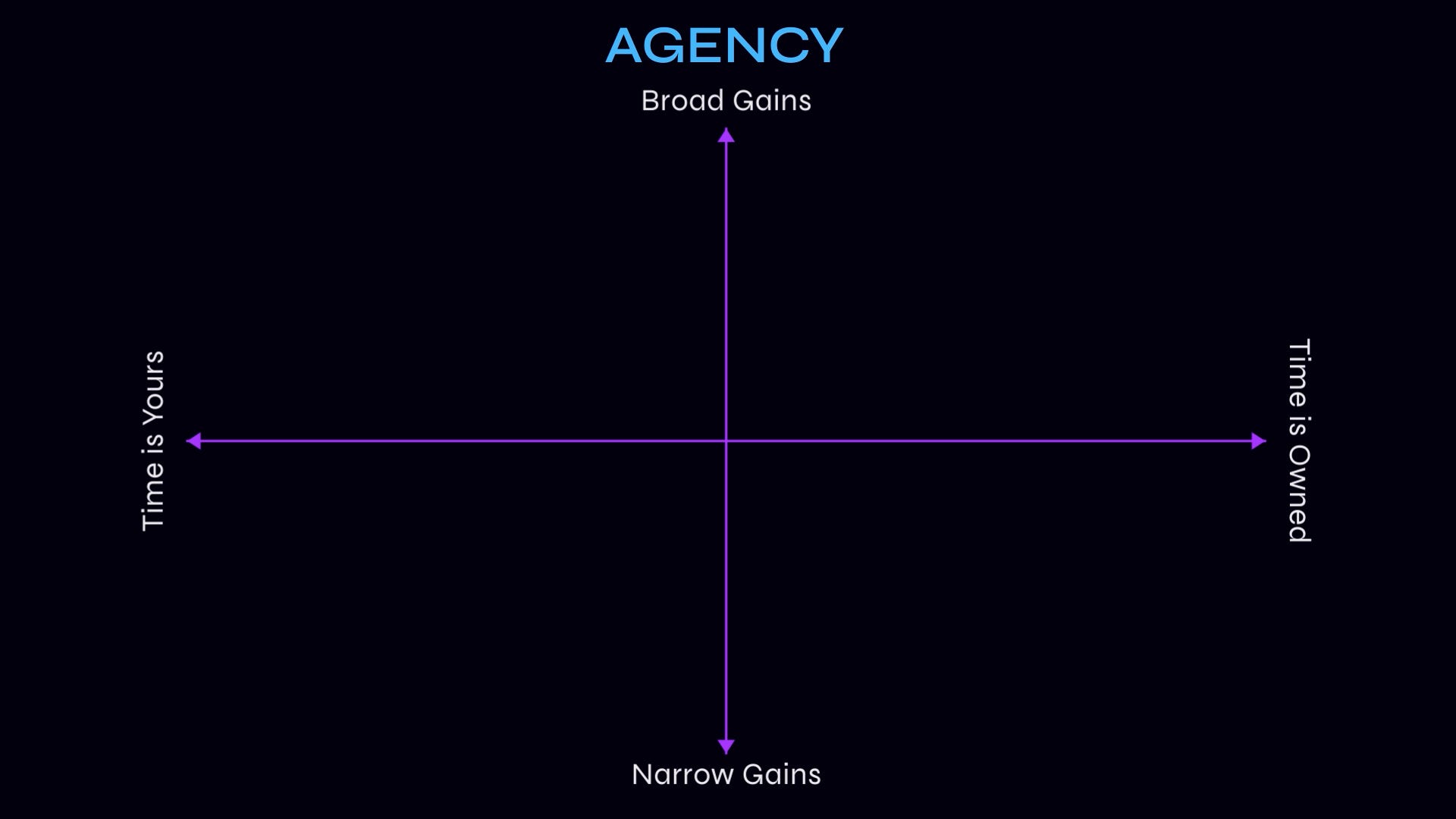
The second dimension has to do with agency, which is a topic I’ve discussed many times on this platform as an essential concept. At the macro level, we asked who holds the power in our system, and who reaps the benefits that are produced. At the personal level, this becomes a question of who actually controls your time, your attention, and your daily decisions, and who benefits from your effort.
Is our time genuinely ours, or does our employer own our daylight hours? Does our mortgage own the anxiety we feel in the evenings, and do social expectations own our weekends? Does our phone own all the tiny gaps of time in between?
We might feel autonomous. I “choose” to check my phone. I “choose” to work late. I “choose” to say yes to the obligation. If I tracked it honestly, I’m not sure who actually decides how my hours get spent, and who captures the value of what I’m doing in those hours.
Think about the four sources of power I talked about in part two: military, political, financial, and technological. At the personal level, those translate roughly to your own biology, social expectations, financial obligations, and the platforms that structure your attention. These are the things we navigate in our daily lives that give us (or remove) our sense of agency and power over our own time and gains.
Someone with broad agency and broad gains is a person whose time actually reflects their values. They’re not necessarily free of obligations; rather, the obligations are mostly ones they chose. The benefits flow back to them and the people they care about.
Someone with narrow agency and narrow gains is living the personal version of a “Captured Democracy” scenario from part two. This is a person whose life looks like freedom, but functions more like a trap. Every day they get to “make” lots of choices, but the choices are mostly predetermined by preexisting obligations, debt, habits, and phone or social media addiction. It all feels like freedom … but it doesn’t really function as such.
So those are the two dimensions we navigate: throughput and agency. They describe what you’re doing with your life. Whether any of it holds up fully depends on what lies underneath.
Foundation: Body and Nervous System
This is the point where the personal scenario thinking diverges from the macro one. At the civilizational level, the two other grids of geopolitics and Earth systems are what constrain everything else. You can have the best economic model and the fairest power structure, but if the biosphere is falling apart and geopolitics is fragmenting, those good choices get quickly overwhelmed.
The same thing happens at the personal level. The foundations are different, because we don’t navigate them the same way we navigate the dimensions I just outlined. They’re slower and deeper, less responsive to conscious decisions. They’re the accumulated result of years of choices, plus stuff we didn’t choose – our childhoods, genetics, traumas, experiences, and just plain luck. They’re the ground our personal composites sit on.
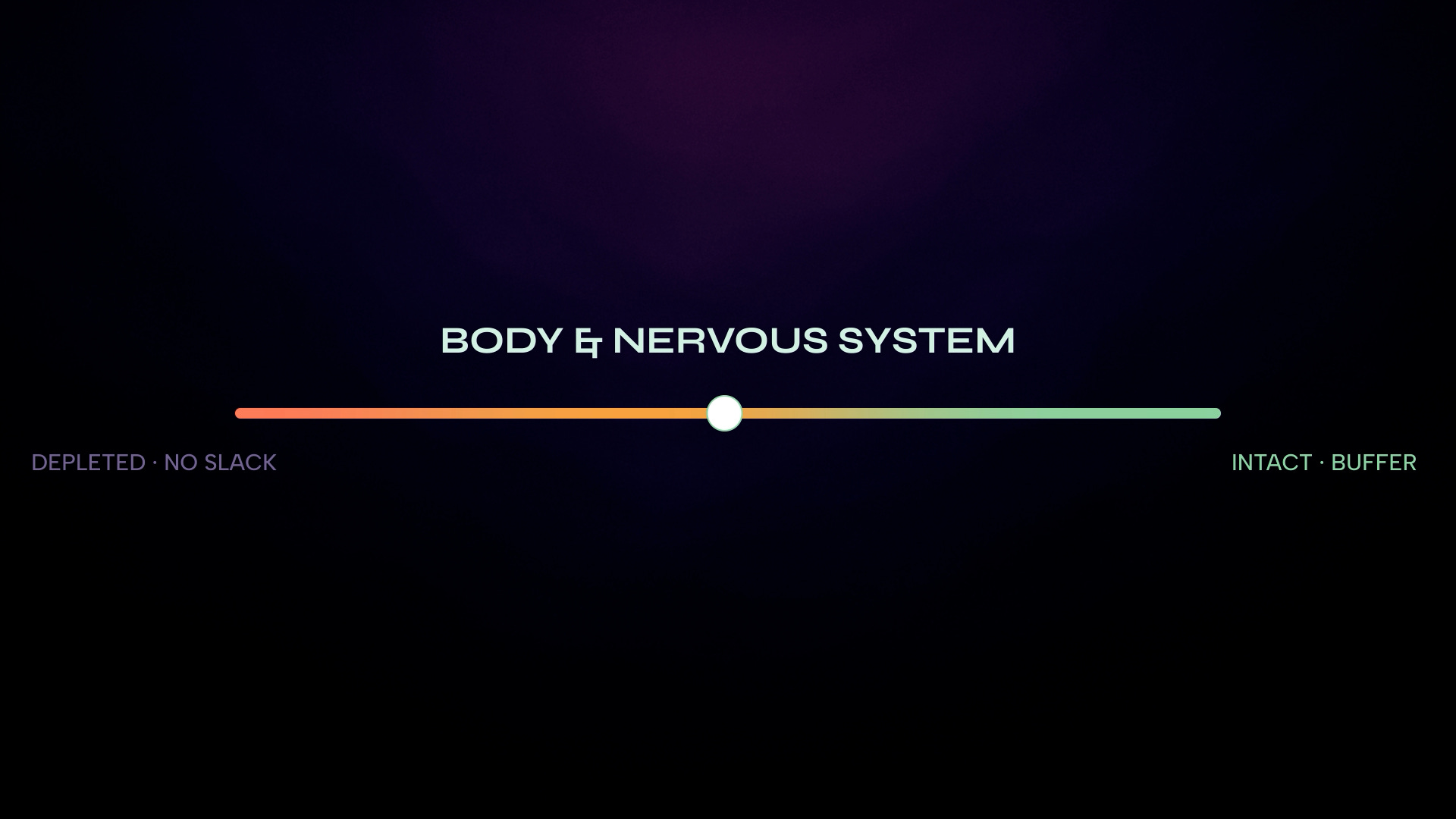
The first one is related to our physical body and its functioning: How much sleep debt are you carrying? How regulated is your nervous system? What’s your baseline when nothing is going wrong? Are you rested and calm and capable? Or are you running on caffeine and cortisol and momentum?
You can ignore this foundation for a little while, maybe even years. Your body will keep performing … but it sets the outer limits on everything else. Like the Earth systems at the macro level, by the time the indicators clearly register that something is wrong, the damage is often pretty advanced and recovery takes a long time, if it’s even possible at all.
A person whose body and nervous system are intact has more slack. They can absorb a bad week. They can think clearly under pressure. A person whose foundations are depleted has no slack and no buffer. Every setback cascades, every demand feels difficult or impossible. It’s not because this person is weak; it’s because there’s not much left to draw on.
Our physical and nervous system foundation is either providing us with options or taking them away. No amount of good strategy on the dimensions above makes up for a foundation that’s crumbling.
Foundation: Relational Web
The other foundation that our personal composites sit on is the web of care and relationships we operate within. This is your personal geopolitics, while your health is your personal biosphere.
This foundation is measured by the quality and depth of your actual human connections in real life. Not your network, or your followers, or your contacts, but the people in your life who would show up at 2am if you called. The people who know what you’re actually going through, and care about you.
This inner network also determines what’s possible when things get hard. If your relational web is strong, a “Personal Long Repair” scenario is a lot more achievable because you have people to simplify with, to share the burden with, to hold you accountable, to remind you who you are when you forget. If this group of humans (or I suppose non-humans) is either thin or adversarial, stress pushes you toward rigidity and isolation – or worse, toward things falling apart entirely – regardless of what you choose in the dimensions above.
So we can make all the right decisions about our throughput and our agency. We might simplify beautifully and reclaim our time. If we do this alone – without deep relationships, without community, without people who actually know us – I think, given what’s ahead, we’re building on sand.
Four Personal Futures
So the four personal composites come together the same way the macro ones did. They emerge from the dimensions and the foundations combined.
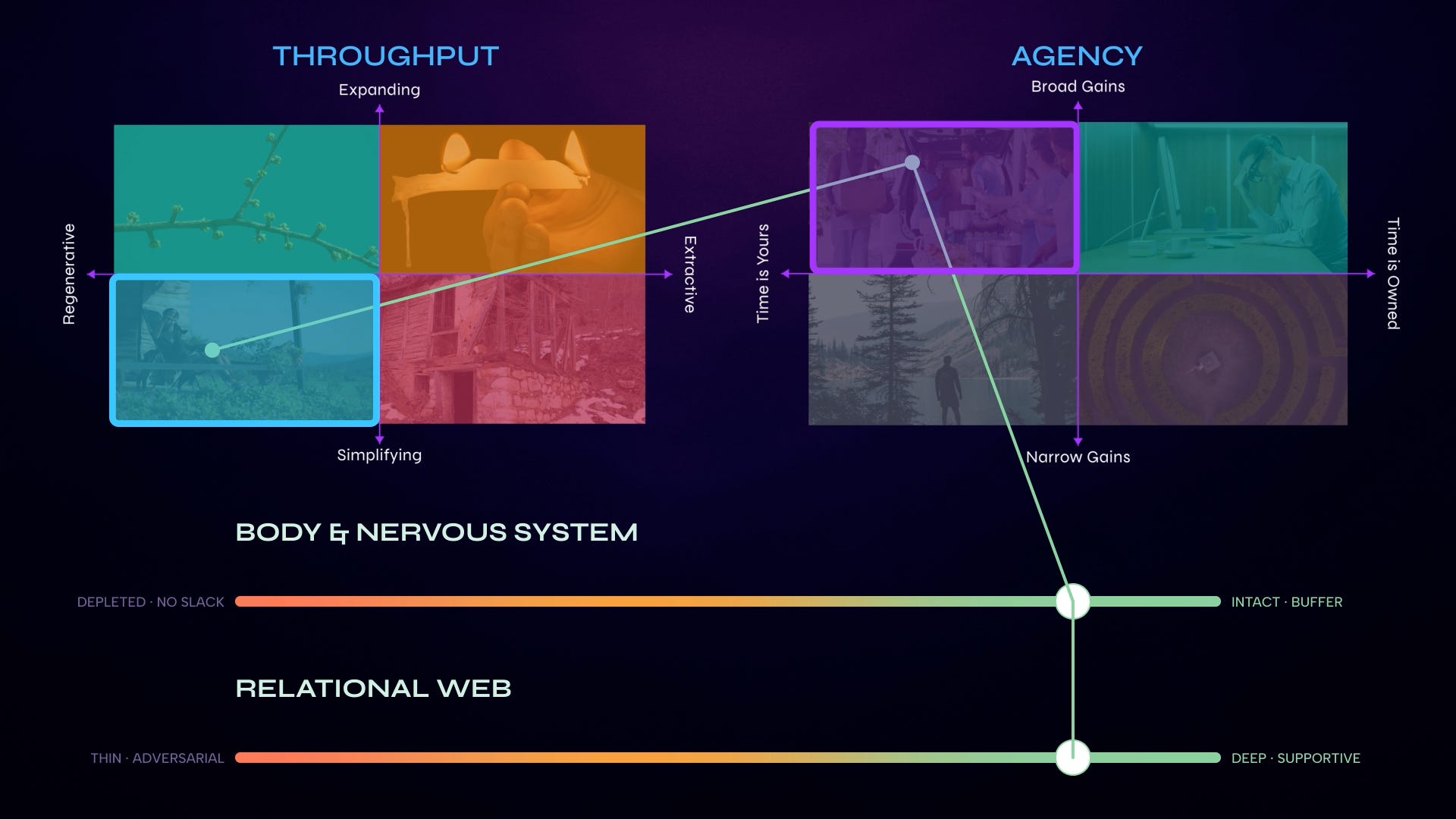
A “Personal Long Repair” looks like deliberately simplifying with genuine agency. The body and nervous system are intact, and you have a strong relational web. This is a hard scenario to achieve. It requires, at a minimum, sustained honesty with yourself. It’s both the hardest personal composite to reach and the easiest to lose: one bad month, seductive job offer, or crisis, and it’s easy to slide back. Still, this is the only personal trajectory that is genuinely regenerative over the long term.
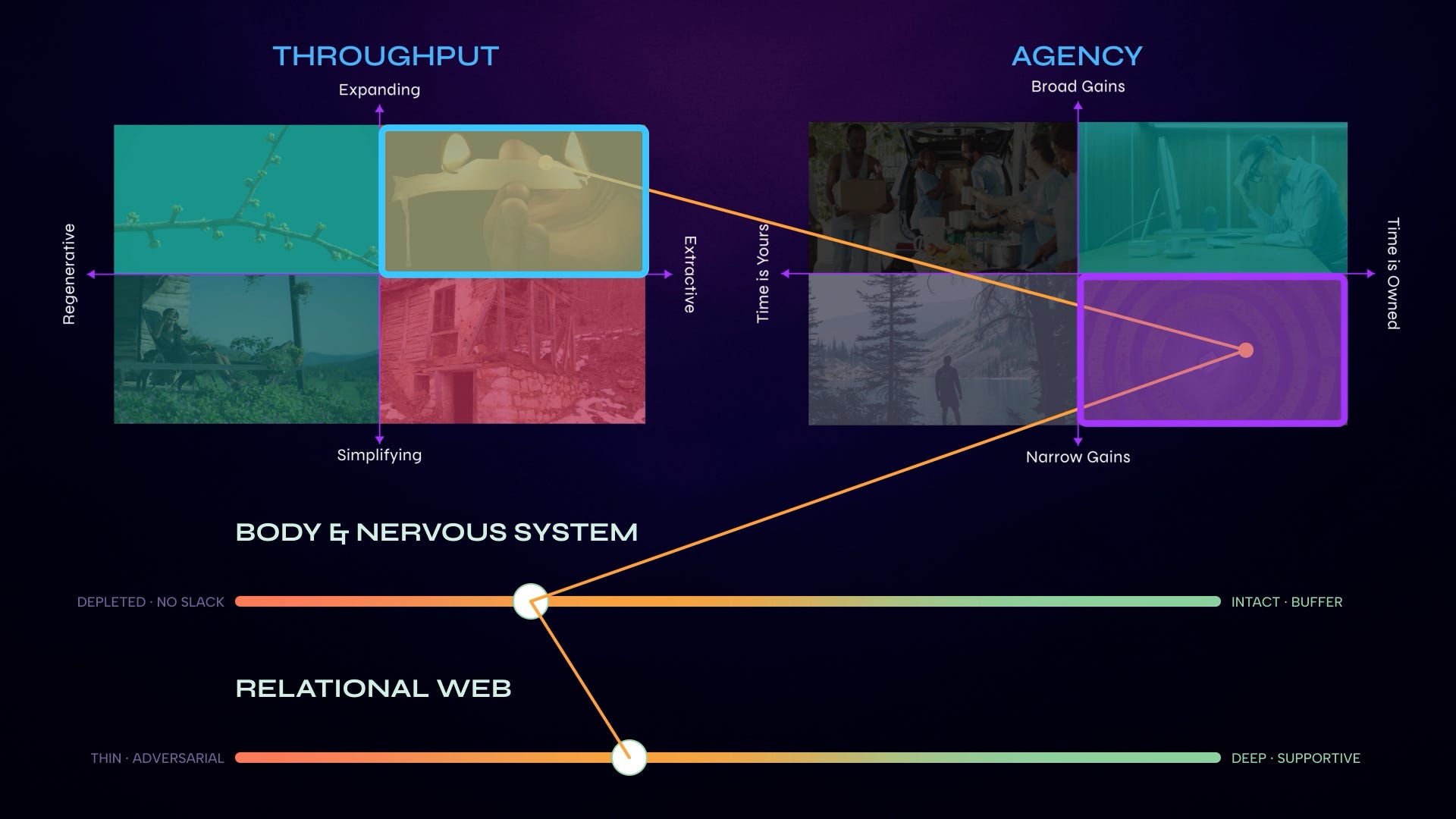
A “Personal Mordor” would mean expanding throughput with captured agency. Your body is quietly depleting, and whatever relationships you have are maintained mostly at a surface level. The scoreboard says everything is fine, but everything is not fine. Just like civilizational Mordor, the danger here is that you use up the resources you’d personally need for a graceful transition out of this scenario: your health, your close relationships, and your time. Once the metrics catch up to reality, your options have narrowed significantly.
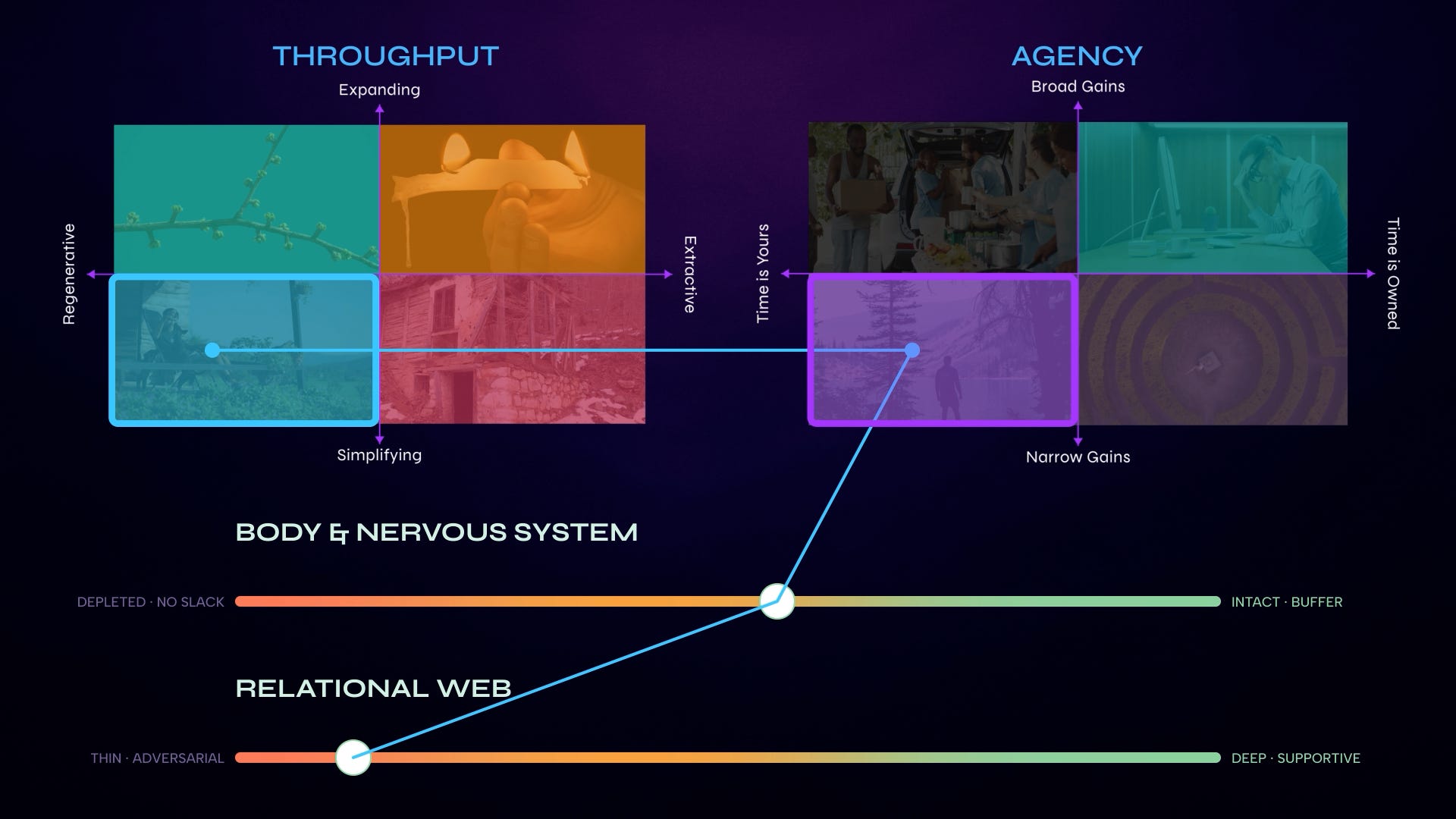
A “Personal Fortress” scenario means walls up, controlling everything. Maybe you’re well-prepped for what’s coming, but you’re doing it alone. Rich in financial capital, poor in all the others. All the prepping but none of the neighbors. This is survivable, sure, but you’re not able to flourish here. We are social beings, and the constant self-management and vigilance that are required here is exhausting. It’s energetically expensive to maintain a personal fortress, same as it is to maintain a civilizational one.
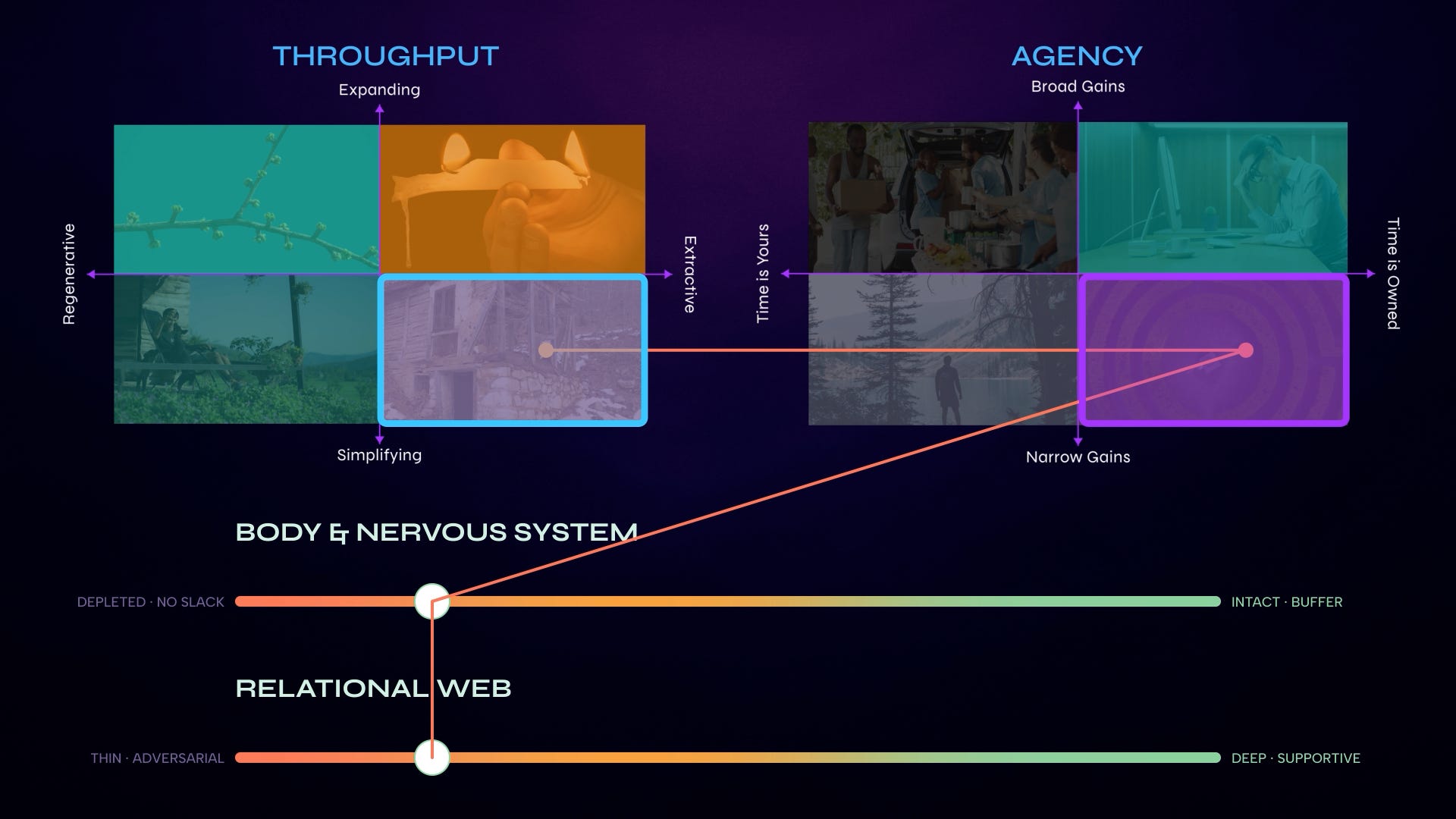
Lastly, a “Personal Unraveling” scenario is where things are coming apart in more than one area at once. Your health is getting worse, your relationships are fraying. There’s no real structure to the days; it’s mostly just reacting to whatever hits next. This scenario doesn’t happen because you’re weak. It’s because the ground you were standing on gave way and everything on top shifted with it. Each setback hits before you’ve recovered from the last one, and there’s very little room for error.
Feedback Loops and Gravity
Just like the macro composites reflect the inner composites, the gravitational pull that creates feedbacks in the civilizational composites also exists in our personal landscapes.
When our bodies are depleted and we don’t really have people around us, our agency shrinks. Our throughput defaults toward “extraction,” because we just don’t have the energy for anything else. Stress plus scarce (personal) energy pulls us toward rigidity, or “Personal Fortress” mode. In the same way, scarcity plus fear pulls toward authoritarian consolidation at the civilizational level. It becomes the path of least resistance. It doesn’t require a decision; it’s just what happens when the foundations erode and we stop switchbacking.
The civilizational asymmetries hold as well. It’s easier to slide from “Personal Long Repair” into “Personal Fortress” under stress than to climb from “Personal Mordor” into “Personal Long Repair.” That’s because that climb requires at least partially giving up the metrics that say you’re fine. It requires looking at the scoreboard and acknowledging that you’re measuring the wrong things. Honestly, that’s the same confusion from part four – healing versus dying – just at the scale of one life.
The personal future most worth building looks like failure to a culture that measures everything by growth, productivity, and busyness.
Personal Switchbacks Over Flashy Fixes
Now, here may be the most important insight I can offer in this essay. Most people trying to change their lives focus on the headline dimensions: What should I do differently? How should I spend my time? What should I consume? What should I cut?
Those are all throughput and agency questions, and they skip the foundations entirely: Am I sleeping enough? Am I mostly calm in my body, and can I return to that calm when stress hits? Do I have people around me who actually know me and care about me? Is my body giving me slack and buffer, or taking them away? Is my relational web strong enough to hold a difficult transition? Do I spend enough time outdoors?
Skipping those questions is the personal equivalent of building economic policy on top of a degrading biosphere. We can have the best plan in the world, but if what’s underneath it is crumbling, the plan doesn’t hold.
I will be expanding on all of this in the ongoing “Guide to Staying Human” series, as I reflect on my own life at this stage of the metacrisis. This foundational work isn’t glamorous … nor is it strategic. It doesn’t feel productive by most metrics our culture respects. It’s sleeping enough, taking walks, cooking food, and sitting with someone without an agenda. It’s the soup you bring to your neighbor, and having the conversation you keep putting off. It’s making the doctor’s appointment you’ve been avoiding. It’s putting the phone down at 7pm even though your brain is insisting on the dopamine.
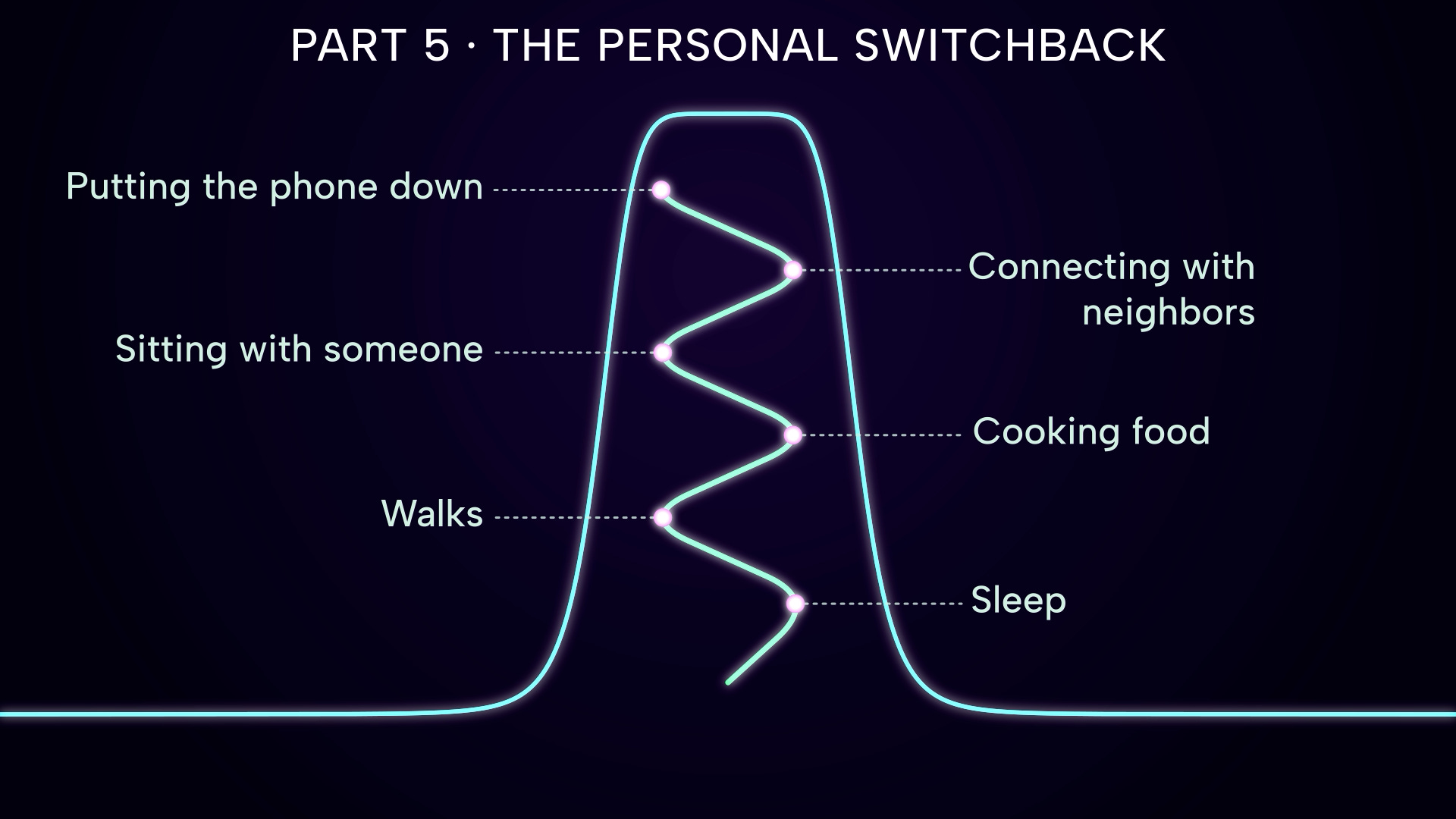
This is what I’m calling “personal switchbacking.” It’s the patient and unglamorous work on the terrain that’s just in front of us. No one other than you is going to see this work or give it “likes.” The progress, just like building cultural switchbacks, builds so slowly we can’t see it week to week. But we can see it month to month and year to year. This is the kind of progress that, when the ground finally shifts underneath us, turns out to be the main thing that keeps us steady and oriented.
I will have a lot more to say about this in the coming months, because more people building these switchbacks in their own life will underpin all the important cultural work ahead of The Great Simplification.
Reflection
So the question I’ll leave with you rhymes with the ones from the macro series, but pointed inward this time.
Which personal composite are you living inside right now? Not which one you want to be in … which one are you actually in today, if you’re being honest?
Are you switchbacking or eroding? At the level of your foundations – your body, your nervous system, your actual human relationships – are you building something that will hold? Or are you letting it wash out while you focus on the dimensions?
The good news is that personal switchbacks are available right now. Today. This week. They don’t require permission, policy, or institutional reform. They just require honesty about where you are and one small act in the right direction. And then another one. And then another one.
Now that we can see both landscapes, the civilizational one and the personal one, the question is how to act inside them. That’s what’s coming in part six. I’ll see you there. Thanks for reading and following along with this series.
Want to support The Great Simplification podcast?
The Great Simplification podcast is produced by The Institute for the Study of Energy and Our Future (ISEOF), a 501(c)(3) organization. We want to keep all content completely free to view globally and without ads. If you’d like to support ISEOF and its content via a tax-deductible donation, please use the link below.
Well now, isn't it interesting that there are no comments after 5 hours. I do a lot of thinking and writing about basics, and I tip my hat to your dedication to seeing clearly and to your body of work that I often get a lot out of.
I did skim this, so I may not be doing it justice, but my impression was that it was very male. Surface stuff of shoulds and oughts and lists and charts.
I do wish you'd see as much of me as I see of you, for ideas you might get from how uniquely I think about the future, where it's paradigm-change or bust -- and maybe paradigm-change and bust!
Here's today's post:
Cat herding and what else to do?
Civilization is at stake
https://suzannetaylor.substack.com/p/cat-herding-and-what-else-to-do
And for what is one preparing? If there is to be a breakdown in provision of fuel and food is one growing a large vegetable garden and bike-riding robustly?
One should be on a humanity and health track, and also whatever-is-neccesary track, at least. Hobbies are interesting and educational too. Gardening, woodwork and bike repair are hobbies I can recommend.
Try meditation on bike rides, but not in traffic. It "kills 2 birds with one stone", so to speak.
;-)